



by Brian Hioe
語言:
English
Photo Credit: 五一行動聯盟/Facebook
TAIWAN HAS SEEN a number of labor demonstrations in recent weeks.
A strike by workers at iconic snack Kuai Kuai’s Zhongli factory came to an end after five days earlier this month. Kuai Kuai is an iconic snack best known for a superstition that keeping bags of it near machinery keeps them running smoothly. Kuai Kuai operates one factory in Taoyuan, but 130 out of 155 union members voted in favor of a strike after the company decided to relocate to Hsinchu.
The two sites are 39 kilometers from each other, meaning that the move is untenable for many workers. Workers were only informed of the land scale on September 1st. According to the Ministry of Labor, the move was not expected for another two years. The factory has operated in Zhongli since 1968, and 1/3rd of workers at Kuai Kuai have worked there for more than thirty years, despite the fact that their wages are near minimum wage.
Though workers initially voted only for a one-day strike, the action was later extended indefinitely. After the strike, workers won four months’ wages plus severance pay if they are reassigned in the Zhongli factory and eight months’ wages plus severance pay if they have to leave their jobs because of the planned reassignment to Hsinchu and resign by September 30, 2028. Workers with twelve years of experience under the labor pension system will receive a further 100,000 NT. Kuai Kuai has stated that it will not lay off workers for two years and that workers who are laid off afterward will receive two months’ wages.
Workers have accused the San-Ti Group that owns Kuai Kuai of perhaps having only acquired the company with an eye on selling its land to Advanced Semiconductor Engineering Inc. Originally, Kuai Kuai workers were only offered a 5% pay increase and verbal assurances that they would be relocated to the new factory. It is to be seen if acquiring land to sell it to technology companies is a tactic increasingly adopted in corporate acquisitions going forward.
To this extent, migrant worker groups have criticized Singaporean company Sheffield Green and Indonesian company PT Kepodang Makmur Sejahtera, both offshore wind manufacturers, of violating the contracts of Indonesian migrant workers. Specifically, despite being skilled workers as fitters, such workers signed contracts that promised pay of 48,000 NT per month, but were later only paid between 100 NT and 143 NT per month. Such groups demonstrated earlier this month.
Such workers were part of projects run by Taiwanese company Century Energy Co., Ltd., but Century Energy has skirted responsibility by stating that it had no responsibility over contracts signed between workers and foreign contractors under a “contract performance” system that allows the company to bring over foreign workers to be part of projects. Under this system, the Indonesian workers were paid less than the minimum salary in the Labor Standards Act.
In response to such criticism, the Ministry of Labor has stated that it will step up inspections. It is to be seen if this actually takes place.
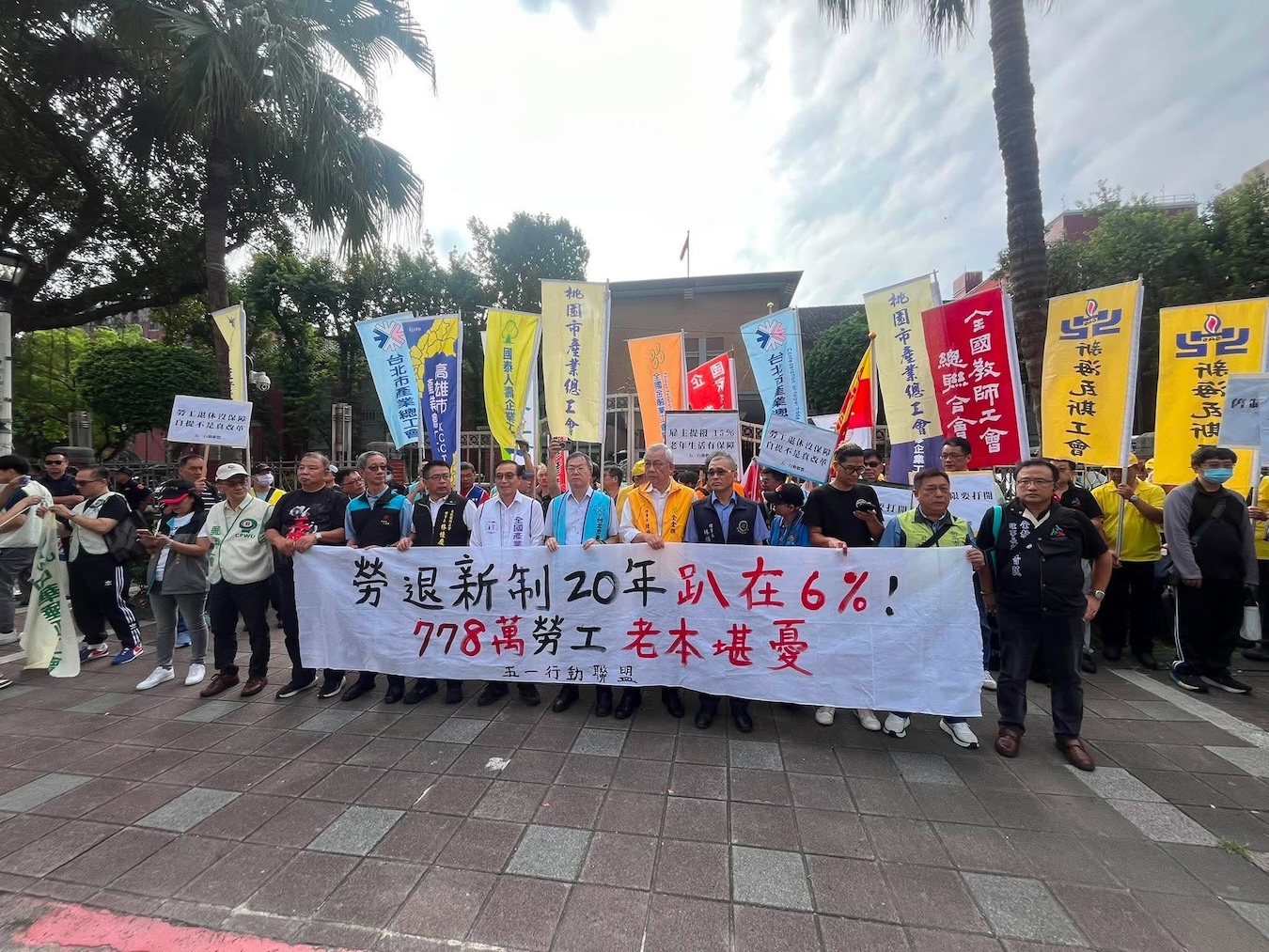
Likewise, the May 1 Action Alliance–a coalition of labor groups–demonstrated outside of the Executive Yuan on October 13th to call for employers to increase the amount of money they contribute to worker pensions. The Action Alliance cited that the mandatory employer contribution rate had remained at 6% since the current pension system was introduced in 2005, though expectations were originally that the rate would increase. As such, calls by labor groups were for the contribution rate to increase to at least 12%.
Though Lai Ching-te had previously pledged to increase the contribution rate as a campaign pledge, there has not yet been action on the issue.
The demonstration was followed up by another demonstration on October 19th. Labor groups, including the Taoyuan Confederation of Trade Unions, Chunghwa Telecom Union, and other organizations, pledged to strike if their demands were not met, calling for higher wages and an increase in employer contributions to worker pensions.
It is to be if labor becomes a campaign issue ahead of elections next month, then. This does not look likely at present, unless candidates are seeking new issues to brand themselves with, but it can be expected that labor groups will seek to pressure the government on the matter.