



by Brian Hioe
語言:
English
Photo Credit: Liu Shu-fu/Presidential Office/Flickr/CC BY 4.0
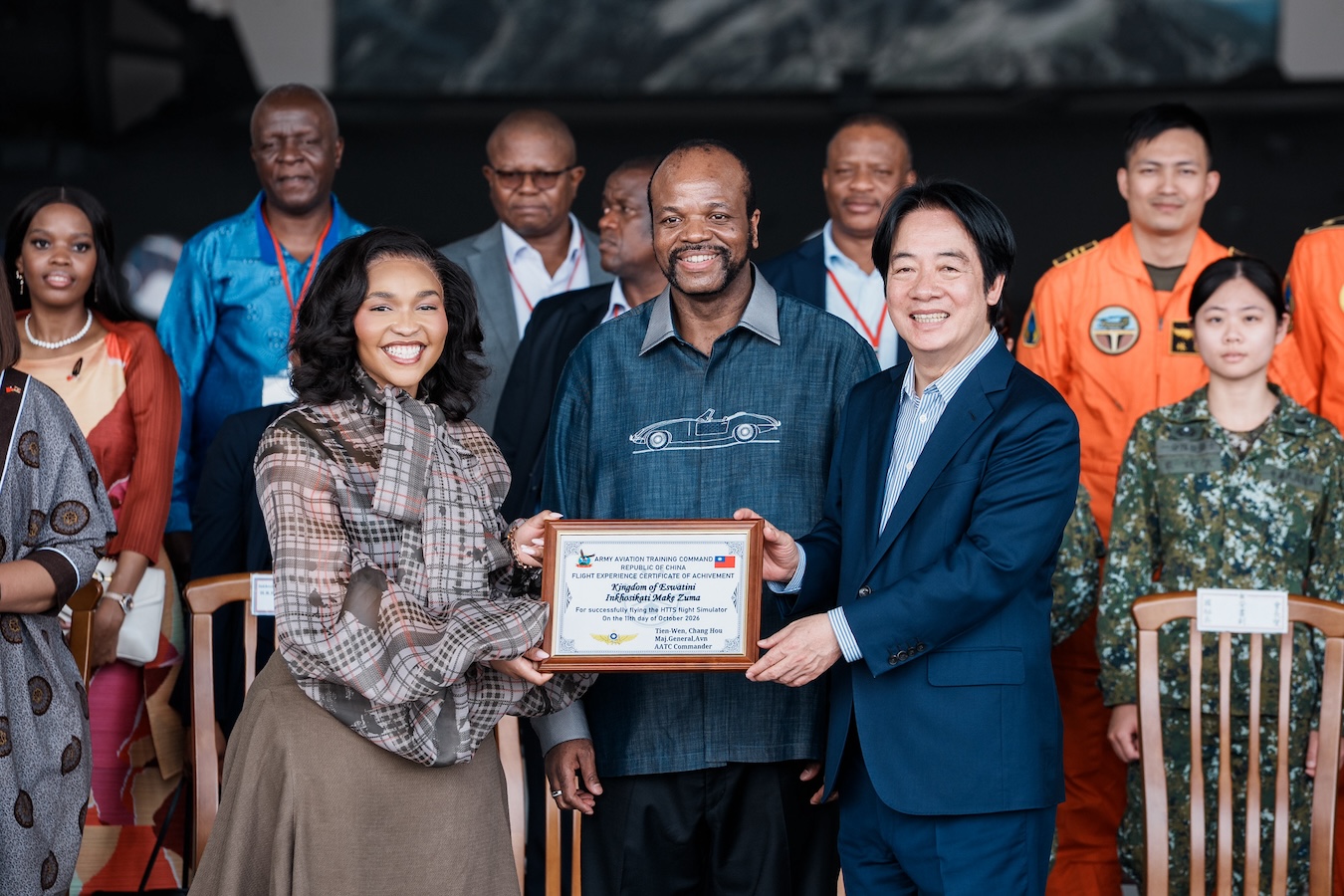
KING MSWATI III of Eswatini was recently in Taiwan for National Day. As a result, the red carpet was once again rolled out for the authoritarian monarch, who presides over Africa’s last absolute monarchy, by the Lai administration.
In particular, apart from Mswati III’s presence at National Day, President Lai Ching-te and Mswati III visited Taiwan’s Air Force Command. Lai touted support from Mswati III on establishing the Taiwan Industrial Innovation Park, as well as Eswatini’s role as Taiwan’s gateway into Africa. Eswatini is Taiwan’s only remaining diplomatic ally in Africa.
Ties between Eswatini and the Lai administration have been in the spotlight in recent years, especially after a dramatic visit to the country by Lai. In May, a planned trip by the Taiwanese president for King Mswati III’s 58th birthday and the 40th anniversary of his accession to the throne was abruptly canceled.
This occurred because countries that Lai would have passed over on his flight to Eswatini, Madagascar, Mauritius, and the Seychelles revoked overflight permissions shortly before Lai was to set out. This was largely interpreted as China flexing its muscles in terms of its influence in Africa, with the Lai administration suggesting that China threatened to revoke debt cancellation for Madagascar, Mauritius, and the Seychelles if they did not comply.
Lai still later traveled to Eswatini aboard Mswati III’s private aircraft. This took place with Lai abruptly traveling to Eswatini, then only announcing that he had arrived after the fact. Presumably, this was to minimize the space for China to react. Lai arrived in Eswatini by traveling on King Mswati III’s personal aircraft, a former China Airlines plane that was sold to the monarch in 2015. Lai later returned on the same aircraft, taking a winding route that tested the operational limits of the plane, but similar to the route taken by then-US Speaker of the House Nancy Pelosi during her August 2022 trip to Taiwan.
Still, one notes that–as is broadly the case with Taiwan’s diplomatic relationship with Eswatini–there was little criticism of Eswatini’s record on human rights afterward. Eswatini is an absolute monarchy. The constitution was voided in 1973, and political parties were banned, as a result of which free and fair elections still do not take place in Eswatini today. Although Mswati agreed to constitutional changes in 2005, he retains his grip on power. Under Mswati III’s rule, life expectancy has halved in Eswatini since 2000.
Pro-democracy protests rocked Eswatini in the summer of 2021, with the public calling for the right to vote. In the violence that followed, 28 were shot, with demonstrators alleging that at least twenty were killed. Tear gas was used by police against demonstrators, and Internet services were suspended, with a curfew declared in major urban centers, in which buildings were burned during the turmoil, including Manzini and Mbabane, as well as the industrial center of Matsapha.
Much as occurred during Taiwan’s authoritarian period, Eswatini also sees the killing of dissidents. In 2023, opposition politician Thulani Maseko was killed by unknown gunmen in a shooting widely suspected of being ordered by the monarchy. Maseko was a human rights lawyer and public intellectual. At the time, Mswati III stated, “People should not shed tears and complain about mercenaries killing them,” implying that he had ordered the killing.
Nevertheless, after the demonstrations, Taiwan announced that it would be donating 637 million NT to the government for reconstruction–an act that makes it complicit in the government’s crackdown on the protests. Either way, Taiwan simply chose to act as though the protests had never occurred.
Indeed, in spite of its human rights violations, Taiwan has continued to blithely engage in trade relations with Eswatini. And Mswati III’s visit to Taiwan and plans for the Taiwan Industrial Innovation Park are the latest such example. Still, in the absence of international criticism of Taiwan’s ties to Eswatini, there will be little incentive for the government to make any changes.