


by Brian Hioe
語言:
English
Photo Credit: Screenshot
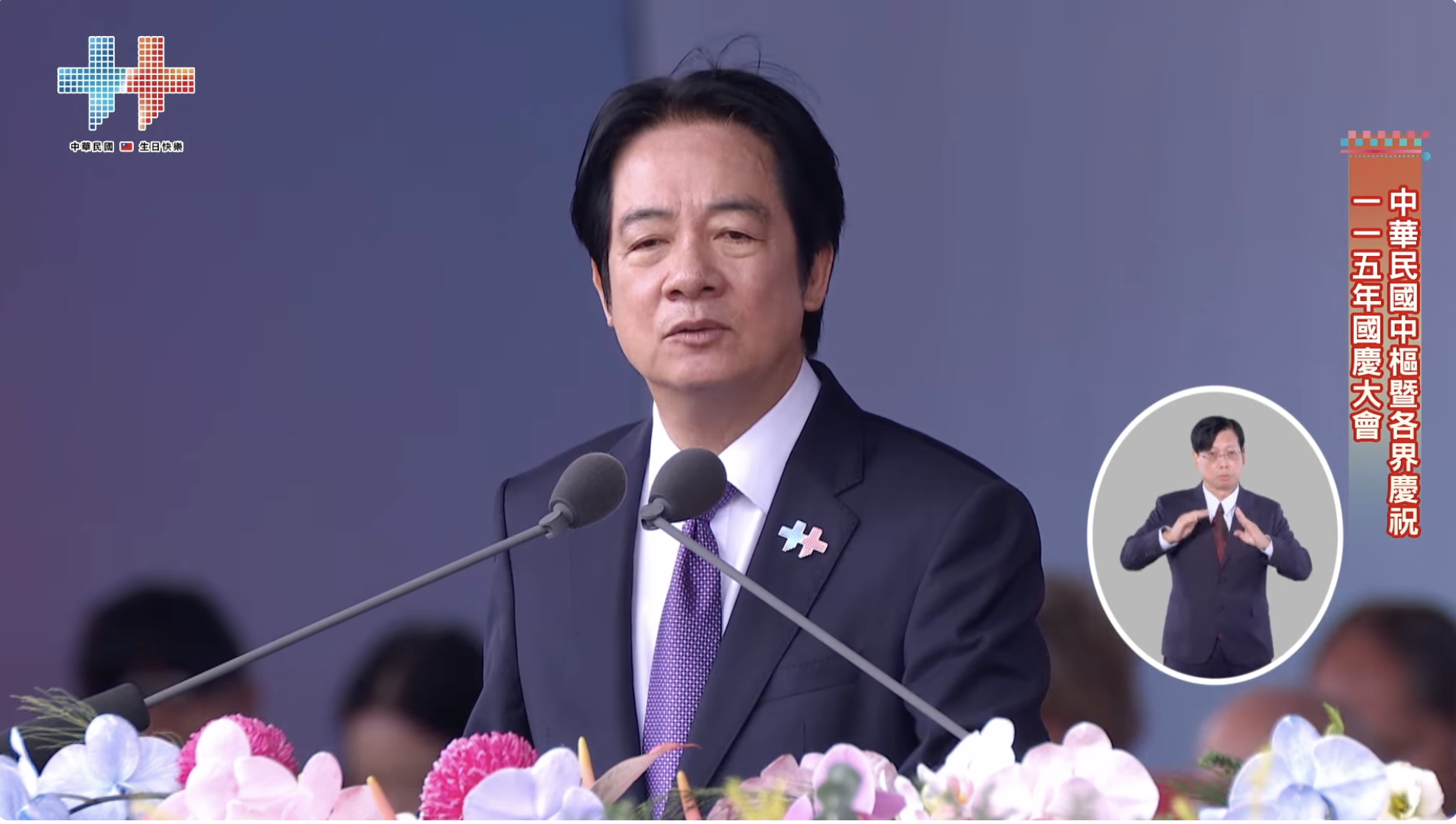
LAI’S NATIONAL DAY address this year largely played it safe. Lai did not introduce any new major proposals, but emphasized that his administration would maintain its existing stances. Notably, Lai could have leaned into attacks on the KMT ahead of elections in November but did not.
Lai began by emphasizing national unity. Lai stated that despite differences in backgrounds, political views, and generations, Taiwan should be united by a responsibility to protect Taiwan and its future. Lai raised, then, that Taiwan recently saw the 30th anniversary of direct presidential elections.
Lai, then, went on to emphasize Taiwan’s resilience in a turbulent international world. The world has seen continued conflict, as well as tariff shocks, but Lai framed Taiwan as remaining committed to non-red supply chains, and becoming part of the foundation of the international order. In this sense, Lai emphasized strengthening ties between Taiwan and its allies, whether that be Eswatini, Palau, or Europe, though, of course, one notes that Eswatini is an authoritarian monarchy. King Mswati III of Eswatini was present at National Day celebrations this year in person.
Lai said that Taiwan should seek to be a “city on a hill” in providing a model for the world.
Lai touted Taiwan’s strong economic performance, along with the accomplishments of its athletes, as signs of Taiwan’s resilience. Nevertheless, Lai also stated that one could not only look at growth numbers in assessing a society, but also whether labor conditions were improving, if young people had opportunities, and if the elderly were cared for. As such, Lai stated that constructing social housing and expanding social welfare would continue.
Lai stated that opportunities for skilled migrant work and efforts to attract international talent would continue, even if priorities would continue to be on the domestic labor force. In this, Lai would be signaling that the expansion of new categories of employment to blue-collar migrant workers would continue, while attempting to allay rising anti-migrant backlash, with the view that the government provides opportunities to migrants but not Taiwanese workers. Lai also stated that efforts to fight drugs and scam centers would ensure social safety, with fines for drugs stiffened. As a “city on a hill,” Taiwan needs to show the world that democracy is effective in caring for society.
In this sense, Lai said that Taiwan would seek to increase its international competitiveness in critical technologies such as AI, semiconductors, and beyond. Taiwan could not only rely on TSMC as the “holy mountain” that protects Taiwan, in keeping the world invested in Taiwan’s defense, but that Taiwan needed a “mountain range.” Cash hand-outs that the government will implement in the near future aim to share Taiwan’s AI dividend with the public. Salaries for teachers, public servants, police, and members of the military would also be increased. Notably, in thanking police, firefighters, and members of the military for protecting Taiwan, Lai also thanked individuals involved in civil defense efforts.
Where elections were concerned, Lai stated that mutual respect was key, as well as that despite differences, political parties should all be committed to protecting Taiwan. Lai urged continued respect in society for sexual freedoms, probably a reference to a recent raid on a gay bar in Taipei. Lai also stated that presidential authority came from the people, referencing the continued divisions between the KMT-controlled legislature and DPP-controlled executive branch.
As for China, Lai did not especially hit out at China besides framing China as disrupting the international order and seeking to distort the history of World War II. Lai stated that defense continues to be important for Taiwan; hence, efforts to increase asymmetric capabilities would remain consistent. At the same time, Lai stated that this did not preclude dialogue, but that shoring up Taiwan’s defenses is in the interests of ensuring dignity and parity in conducting dialogue. Lai emphasized Taiwan as seeking to maintain the peaceful status quo, and that it values peace but will not give up its freedom.
Lai closed on the note of calling for the ROC–and Taiwan–to continue to strive.
Indeed, Lai’s speech was preceded by a speech by Han Kuo-yu as Legislative Yuan president in which he, too, called for unity, but also lashed out in vague terms at Lai for being “dictatorial.” It is probable that Lai was aiming to project a sense of rising above partisanship, for fear that his government, if perceived as overly partisan, would have a negative impact on its election chances next month, when the public goes to the polls.
Though the usual suspects will probably harp on about the number of times Lai referenced “China” (中國), the “Republic of China” (中華民國), or “Taiwan” (台灣), one notes that China (中國) is only mentioned twice in the speech, the US once, and the Republic of China twice, while Taiwan is mentioned several dozen times. That the Republic of China came up was to fend off critics who would depict Lai as a disruptor of the cross-strait status quo, but one notes that China was not the key focus of Lai’s speech.
Elections next month, after all, will mostly be about local domestic issues. Even so, that Lai did not emphasize any new programs, but touted existing ones, may be to downplay his own presence and involvement in the DPP’s electoral strategy–while counting on the KMT to self-destruct, as seen in internal splits in the KMT due to chair Cheng Li-wun being perceived as deeply pro-unification, or Taipei mayor Chiang Wan-an’s recent stumbles. The DPP is probably conscious of how the failed Great Recall Movement last year occurred partly because the recalls became too closely associated in the public eye with Lai, as a result of which Lai did not aim to rock the boat in any way with his National Day speech.